

Three-Part Blog Series: Africa’s Reading Crisis & the Path to Transformation
Part 2
Introduction?
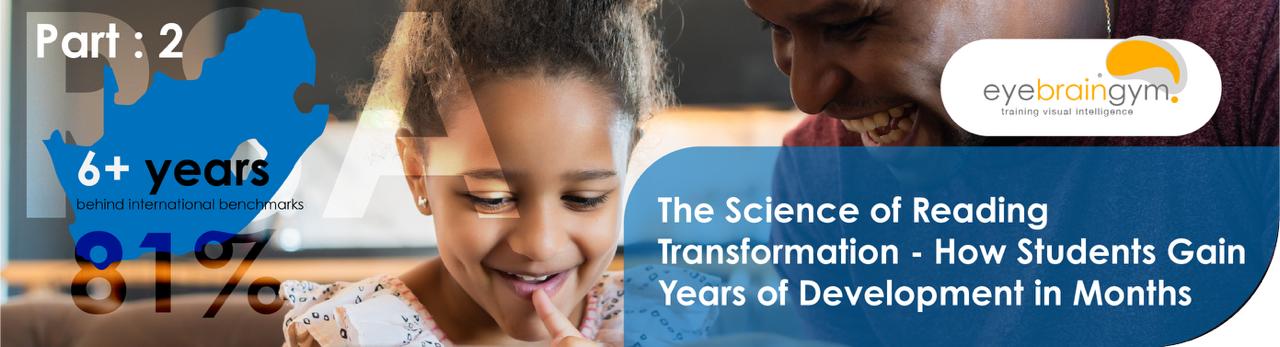
In our previous blog, we confronted the harsh reality: 81% of South African Grade 4 students cannot read for meaning, placing the nation last among 57 countries in international assessments. But what if there was a way to reverse this trajectory? What if students could gain not just months, but years of reading development in a matter of weeks?
It sounds too good to be true. Yet across five peer-reviewed studies involving 17,155 students, this is precisely what has been demonstrated through eyebraingym. This gamified visual intelligence platform should be transforming how we approach literacy development in Africa.
The Science Behind The Solution
To understand how rapid reading improvement is possible, we need to understand how reading actually works in the brain.
The Reading Process: Reading isn’t a single skill – it’s a complex orchestration of visual processing, cognitive decoding, memory, and comprehension. When you read, your brain must:
- Clearly see and track words with coordinated eye movements
- Quickly recognise and decode orthographic patterns (letter combinations)
- Access word meanings from memory automatically
- Integrate information into a coherent understanding
- Hold and process information in working memory
For struggling readers, this process is painfully slow. They spend so much mental energy on decoding individual words that little cognitive capacity remains for understanding meaning.
The Bottleneck: Research from cognitive load theory shows that working memory can hold only about 7 items for roughly 10 seconds. If a student’s working memory is consumed by laboriously sounding out words, there’s no capacity left to comprehend what those words mean. It’s like trying to understand a conversation while simultaneously translating from a foreign language – the cognitive burden is simply too heavy.
The Key to Transformation: Automaticity. When word recognition becomes automatic – when the brain can process orthographic patterns instantly without conscious effort – working memory is freed to focus on comprehension. This is the fundamental principle behind eyebraingym’s approach.
How eyebraingym Works?
eyebraingym is an online, gamified platform designed to develop the foundational and advanced skills that enable fluent reading systematically:
- Eye-Gym Exercises– Training the Visual System
The platform includes specialised exercises that develop:
- Perceptual Accuracy: Recognising patterns quickly and correctly
- Visual Efficiency: Smooth, coordinated eye movements across text
- Visual Memory: Retaining and recalling visual information
- Visual Tracking: Following text without losing place or skipping words
These aren’t arbitrary games – they’re targeted exercises based on understanding how the visual system processes written language.
- Vocabulary Development– Building the Mental Lexicon
Through exercises like WordFlash and PhraseFlash, students rapidly expand their recognition vocabulary. The platform uses:
- Mind-activation exercises (including pre-reading strategies)
- Rapid word exposure to build automatic recognition
- Progressive difficulty adjustment
- Context-rich phrase practice
- Silent Reading Fluency Training– Developing Speed with Comprehension
Students’ progress through:
- Word-by-word projection (slot-reading) to develop tracking
- Line-by-line reading with pacing
- Full page reading with adjustable speed
- Graduated text complexity
- Comprehension Skills Development– Making Meaning
The platform explicitly teaches:
- Pre-, during, and post-reading strategies
- Question answering and sentence completion
- Sequencing and organisation
- Skimming, scanning, and summarisation
- Metacognitive awareness (thinking about thinking)
The Neuroplasticity Advantage
The power of eyebraingym rests on a fundamental truth about the human brain: neuroplasticity – the brain’s ability to form new neural connections and rewire itself through experience.
Research shows that:
- The brain is a self-organising system that creates new synaptic connections during learning
- Focused, continuous use reinforces neural pathways, making them stronger
- It takes 8-12 weeks of focused interval training to establish new neural patterns
- Repetition strengthens pathways, making actions automatic over time
This is why eyebraingym uses interval training – students complete sessions twice weekly over 3-5 months, allowing time for neural consolidation between sessions. Just as you wouldn’t try to build muscle by lifting weights for 10 hours straight, you can’t rewire reading pathways through marathon sessions. The intervals matter.
Measuring Success: Three Critical Factors
eyebraingym measures progress through three scientifically validated factors aligned with international reading norms:
Visual Processing Factor (VPF):
- Measured in words per minute
- Includes text complexity adjustment
- Grade 8 benchmark: 204 words per minute
Cognitive Development Factor (CDF):
- Measured as comprehension percentage
- Incorporates content difficulty
- Assesses both literal understanding and inference
Action-Interpret-Understand Factor (AIUF):
- Combines VPF and CDF
- Expressed as grade-level reading efficiency
- Correlates with international frameworks like LEXILE
These aren’t arbitrary measures – they’re based on decades of reading research, particularly the work of Taylor, Frackenpohl, and Pettee (1960), whose norms remain internationally recognised.
The Implementation Model
The standard eyebraingym program follows a clear protocol:
Session 0 – Placement Assessment:
- Visual processing evaluation
- Language proficiency assessment
- Reading fluency and comprehension baseline
- Generation of personalised game plan
Sessions 1-15 – Intervention:
- 15 sessions delivered twice weekly
- 20-40 minutes per session
- 3-5 months total duration
- Adaptive difficulty progression
- Real-time performance tracking
Final Assessment:
- Comprehensive re-evaluation
- Comparison to initial placement
- Grade-level proficiency determination
Why It Works: The Trasnfer Effect
One of the most compelling aspects of reading development is how improvements transfer across all academic subjects. When students at JNB Private Boys College improved their reading, they also saw gains in mathematics – from 65% to 70%. Why?
Cognitive Load Reduction: Students who read efficiently spend less mental energy on decoding, freeing working memory for problem-solving.
Information Access: Mathematics word problems require reading comprehension. Science demands understanding written procedures. All subjects involve accessing text-based information.
Study Skills Enhancement: Faster reading enables more homework to be completed. Better comprehension reduces re-reading—improved focus transfers across tasks.
Confidence and Engagement: Success in reading creates positive momentum that spreads to other areas of learning.
The Digital Advantage
eyebraingym’s fully digital platform offers several critical advantages:
- Scalability: Can serve unlimited students simultaneously
- Accessibility: Works on computers, tablets, and smartphones
- Flexibility: Effective in computer labs or remotely
- Data-Driven: Real-time progress tracking and reporting
- Adaptive: Automatically adjusts difficulty to student performance
- Cost-Effective: Lower per-student cost at scale compared to traditional tutoring
This proved especially valuable during COVID-19 lockdowns, when traditional interventions were impossible, yet eyebraingym students continued to make gains remotely.
The Promise
The science is precise: reading difficulties aren’t permanent learning disabilities for most students. They’re skill deficits that can be systematically addressed through targeted, evidence-based intervention. When we provide the right tools, based on sound neuroscience, and allow sufficient time for neural consolidation, dramatic improvements are possible.
But does this theory translate to real-world results? Can these principles actually move the needle on Africa’s literacy crisis?
In our final blog, we’ll examine the hard evidence – the outcomes from five peer-reviewed studies, the students whose lives have been transformed, and the roadmap for scaling this solution to reach millions of children across the continent.
The science is sound. The platform is proven. Now let’s look at the results.
For more information about eyebraingym and implementation opportunities, visit www.eyebraingym.com or contact info@lectorsa.com


